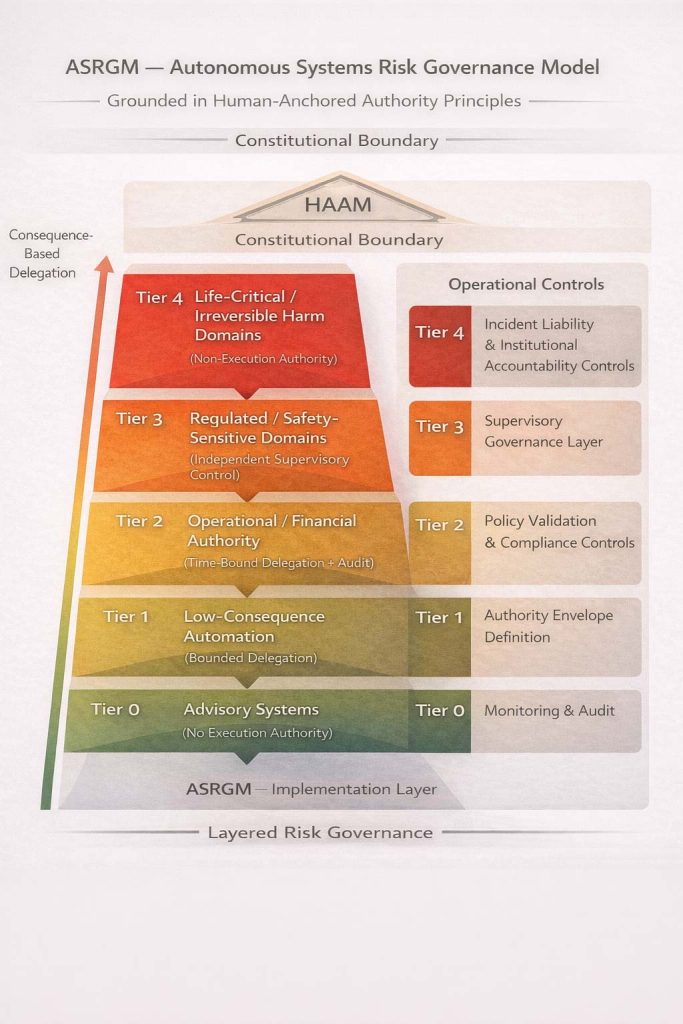
HAAM defines the constitutional boundary within which autonomous systems may operate.
It establishes that execution authority originates from accountable human institutions and may only be delegated within defined structural limits.
Autonomy does not create authority.
It operates under it.
Legal and fiduciary responsibility are non-transferable.
No system, model, or agent assumes institutional liability.
Autonomous execution does not dilute board or executive accountability.
Delegation modifies execution.
It does not modify responsibility.
Delegated authority must be:
Where risk escalates, authority contracts.
HAAM ensures that autonomy expands only within enforceable envelopes.
Where consequence exceeds predefined thresholds:
Life-critical or irreversible harm domains require non-detachable human authority.
HAAM defines the constitutional boundary of delegated autonomy.
The Authority Doctrine establishes the governing principles.
ASRGM operationalises those principles as structured governance architecture.
Authority precedes delegation.
Delegation precedes execution.