
ASRGM
Autonomous Systems Risk Governance Model
ASRGM is a structural classification model for determining when, where, and how autonomous systems may execute within enterprise environments.
It does not evaluate model accuracy.
It defines execution admissibility.
Autonomous systems are assigned to consequence tiers based on risk exposure, regulatory sensitivity, and authority delegation boundaries.
Execution power is granted only within structurally defined limits.
How ASRGM Is Applied in Practice
ASRGM is not a conceptual framework.
It is deployed as:
- Governance mandate definition workshops
- Risk envelope calibration with executive authority
- Technical control mapping to identity & infrastructure
- Audit and observability integration
- Production readiness gating
Governance is implemented as enforceable architecture.
Engagement Path
- Production readiness assessment
- Governance architecture mapping
- Delegated autonomy calibration
- Implementation oversight
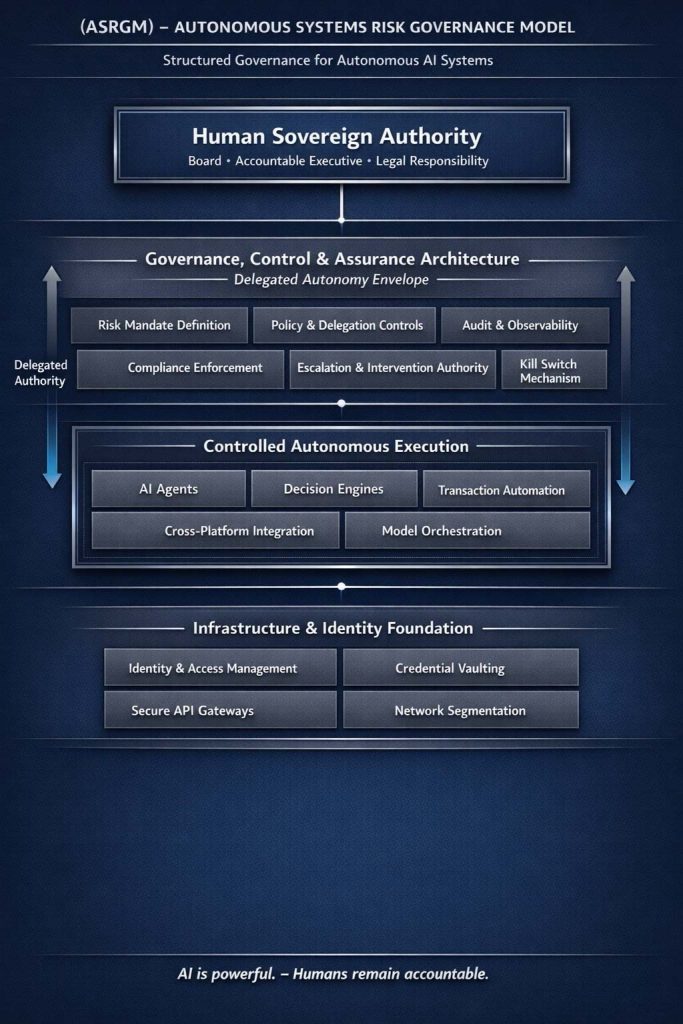
“ASRGM defines the governance architecture required for controlled delegation of autonomy in enterprise AI systems.”
ASRGM establishes three non-negotiable structural layers for enterprise autonomous systems.
A. Human Sovereign Authority
- Board accountability
- Legal responsibility
- Executive mandate
- Why AI does not remove fiduciary duty
B. Governance, Control & Assurance Architecture
- Delegated autonomy envelope
- Risk mandate definition
- Policy & delegation controls
- Audit & observability
- Escalation & intervention authority
- Kill-switch authority
C. Infrastructure & Identity Foundation
- Enterprise identity integration
- Access control
- Logging & audit integrity
- Security alignment
- Change control discipline
Structured implementation proceeds in four phases:
Deliverable: A board-aligned governance architecture ready for controlled production deployment.